## A Cosmic Dance of Light: My Evolving Perspective on the Universe
There are moments when gazing at the cosmos feels like peering into a meticulously crafted, impossibly complex engine. For years, my world revolved around the very real, tangible components that allowed us to *reach* that engine, to touch the vacuum and witness its marvels firsthand. Now, my vantage point has shifted dramatically, from the sterile confines of laboratories and assembly lines to the wonderfully chaotic symphony of a home filled with laughter and the constant hum of discovery.
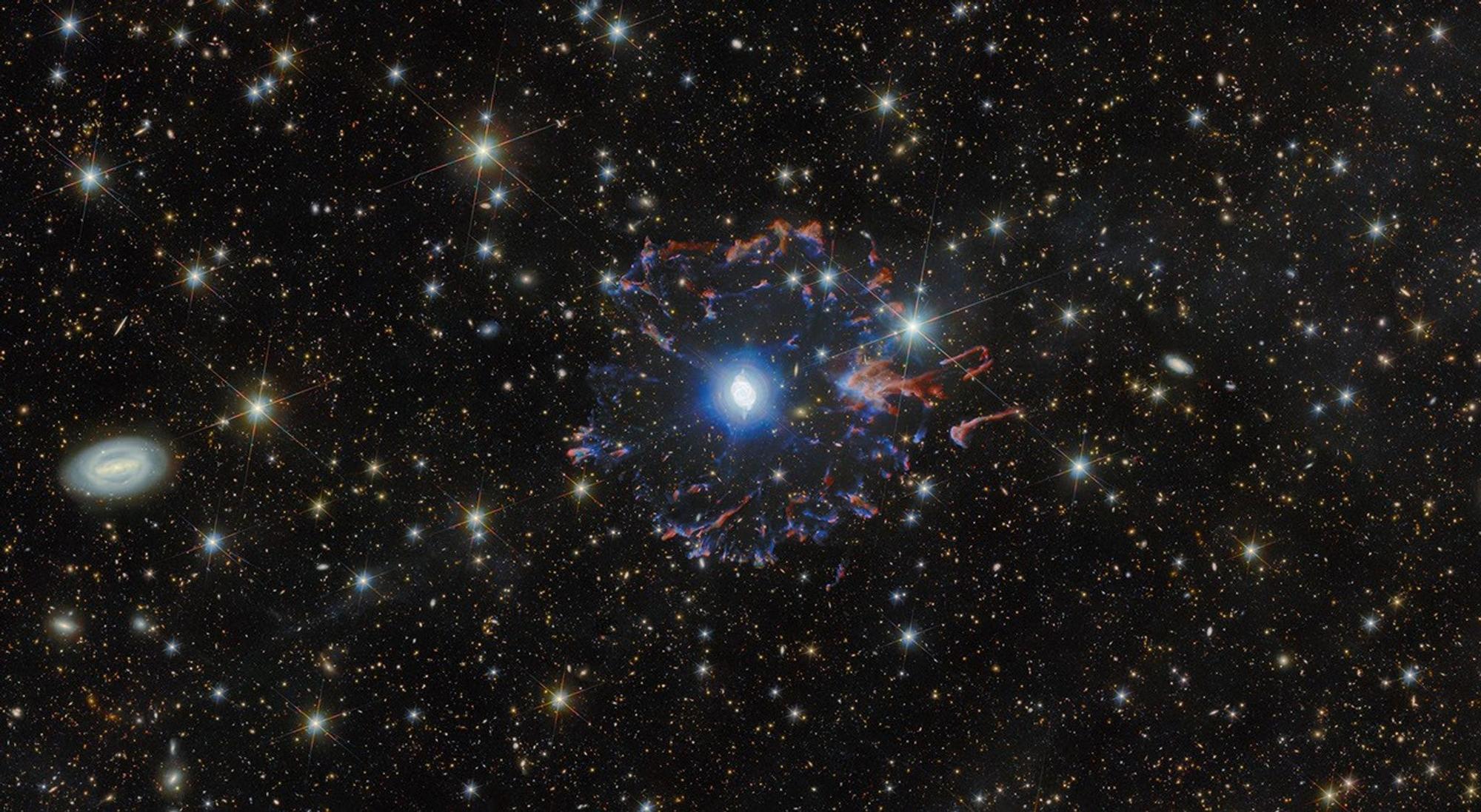
This new perspective, while vastly different on the surface, has profoundly shaped how I see images like the one from the Hubble and Euclid telescopes, capturing the breathtaking Cat’s Eye Nebula. It’s no longer just about the scientific data or the engineering feats required to get us there. It’s about the **story** these celestial images tell, a story that resonates deeply with my own journey.
The Cat’s Eye Nebula, or NGC 6543, is a prime example. Euclid, with its sweeping, near-infrared and visible light vision, paints a broad stroke, revealing the nebula’s vibrant, central region as if it’s cradled within a halo of ejected fragments. It’s like seeing the initial blueprint of a magnificent structure, the foundational pieces scattered before the main edifice takes shape. This hints at the dramatic life cycle of stars, the violent, yet beautiful, processes of their demise. Having spent time wrestling with materials that could withstand the extreme conditions of launch and re-entry, I understand the immense forces at play in creating such cosmic spectacles. The sheer energy required to eject gas in such a manner is staggering, a testament to physics on a scale we can barely comprehend.
Then comes Hubble, delivering its signature high-resolution visible-light punch to the very heart of the nebula. This is where the fine details emerge, the delicate filaments and billowing gas that give the Cat’s Eye its name. It’s akin to zooming in on a critical component in a complex system, understanding its intricate design and function. The precision required by Hubble to capture these nuances is something I deeply appreciate. It reminds me of the painstaking attention to detail needed to ensure the integrity of every single bolt, every weld, every thermal blanket on a spacecraft. Safety, after all, is paramount, whether you’re talking about preventing a catastrophic structural failure on the Shuttle or ensuring the clear transmission of scientific data from a telescope billions of miles away.
What truly captivates me now, however, is how these incredible instruments, operating across vast cosmic distances, can reveal so much more than just the nebula itself. Against the backdrop of distant galaxies, the Cat’s Eye Nebula stands out not as an isolated anomaly, but as a vibrant participant in the grand cosmic ballet. This juxtaposition – the local astrophysical beauty intertwined with the farthest reaches of the universe – is something I find increasingly profound. It’s a reminder that even the most monumental of human endeavors, like building and operating the Space Shuttle, are but tiny threads in an infinitely larger, more intricate tapestry.
My years immersed in the rigorous, demanding world of space exploration, focusing on the very materials that held us together and the unwavering commitment to safety, have instilled in me a deep appreciation for the science and engineering behind such discoveries. But my current role, as a mother meticulously observing the universe through the eyes of my children and the advancements of our space agencies, has added a layer of wonder and awe that transcends the technical. It allows me to see these cosmic images not just as data points, but as breathtaking narratives of cosmic evolution, reminding us of our place within this vast, dynamic universe. It’s a perspective shift, from building the means to observe, to observing with a profound sense of connection.
Leave a Reply