## A Cosmic Dance of Galaxies: Webb and Chandra Unite in a Stunning Spectacle
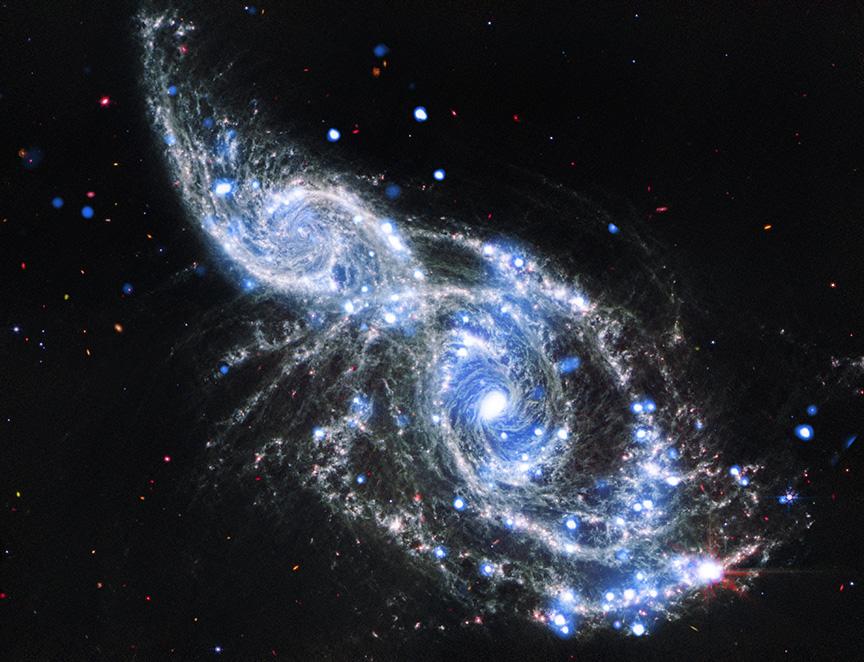
The universe, in its infinite grandeur, often presents us with scenes that defy our wildest imaginations. One such spectacle, captured by the combined might of NASA’s James Webb Space Telescope and the Chandra X-ray Observatory, is the breathtaking image of two colliding spiral galaxies. This isn’t just a pretty picture; it’s a profound glimpse into the dynamic processes that shape our cosmos, a testament to the intricate ballet of matter and energy playing out across vast distances.
The image, released on December 1, 2025, showcases the dramatic interaction of these celestial giants. As they spiral into one another, gravitational forces tear and twist their delicate arms, igniting star formation in their wake. The vibrant colors, rendered by Webb’s infrared gaze, highlight the dusty nurseries where new stars are born, while Chandra’s sharp X-ray vision pierces through the obscuring dust to reveal the energetic phenomena at the heart of these galactic collisions, such as superheated gas and the activity around a central black hole.
This “galactic embrace” isn’t merely a snapshot; it’s a story of cosmic evolution. Collisions like these are not uncommon in the universe. They are the engines of galactic growth, merging smaller galaxies into larger ones, and fueling the birth of countless stars. Studying these events allows us to understand how galaxies form and change over billions of years, providing crucial data points for our cosmic models. The juxtaposition of Webb’s infrared light, revealing the cooler, dust-enshrouded regions and star-forming areas, with Chandra’s X-ray data, exposing the hotter, more energetic processes, offers a uniquely comprehensive view of this monumental event. It’s a layered narrative, where different wavelengths of light tell different parts of the same grand story.
—
## From Launch Pads to Lullabies: A Familiar Kind of Engineering
Watching the latest breathtaking images from space, like the recent “A Galactic Embrace” showcasing colliding galaxies, always brings a certain… resonance. It’s like seeing a familiar echo, a whisper from a time when my focus was on the tangible, the meticulously engineered, the sheer audacity of sending human-made objects beyond our atmosphere.
My days used to be filled with the hum of machinery, the scent of specialized solvents, and the satisfying click of components locking into place. The Space Shuttle, that magnificent marvel of engineering, was my playground. From 2005 to 2010, and then again from 2017 to 2019, I was deeply immersed in the materials and processes that made those flights possible. My specialization wasn’t just about selecting the right alloys or ensuring the thermal protection systems could withstand the inferno of re-entry; it was about understanding the *how* and the *why* of every single piece. Safety was paramount, woven into the very fabric of our work. Every decision, every weld, every coating had to be scrutinized through the lens of preventing failure, of ensuring the astronauts’ return.
Now, my world revolves around a different kind of complex system: four energetic children. The immediate, tangible challenges of space shuttle hardware have been replaced by the equally demanding, albeit less explosive, requirements of snacks, scraped knees, and bedtime stories. Yet, there’s an uncanny overlap in the underlying principles.
Think about it. When we were designing the shuttle’s thermal tiles, we weren’t just slapping on some ceramic. We were analyzing material properties under extreme stress, understanding how they reacted to heat, pressure, and vibration. We were constantly looking for ways to optimize, to make them lighter, stronger, more reliable. We were, in essence, engineering for survivability in an incredibly harsh environment.
This ingrained way of thinking, this constant drive for understanding the fundamental behavior of materials and systems under duress, absolutely informs how I view the incredible advancements we’re seeing in space exploration today. When I look at an image like the colliding galaxies captured by Webb and Chandra, I don’t just see the pretty colors. My mind immediately goes to the instruments themselves. How were those incredibly sensitive mirrors fabricated and polished to such astonishing tolerances? What materials are used in Chandra’s detectors to capture those faint X-ray signals with such precision?
The same meticulous attention to detail that went into ensuring the shuttle’s heat shield could survive re-entry is now applied to creating telescopes that can peer billions of years into the past. The processing techniques, the understanding of how materials behave in extreme conditions – whether it’s the vacuum of space or the fiery plunge back to Earth – these are the silent heroes behind every stunning cosmic revelation. It’s a different scale, a different application, but the foundational engineering mindset, the relentless pursuit of understanding and optimizing, remains the same. It’s a familiar kind of engineering, just happening on a much, much grander scale, and it’s utterly captivating to watch from my vantage point, even if it now comes with a soundtrack of giggles and demands for juice boxes.
Leave a Reply