Here’s a blog post summarizing the Calabash Nebula, written from the perspective of a former Space Shuttle Materials and Processing engineer, now a stay-at-home mom.
## The Cosmic Egg We Oughta Crack Open
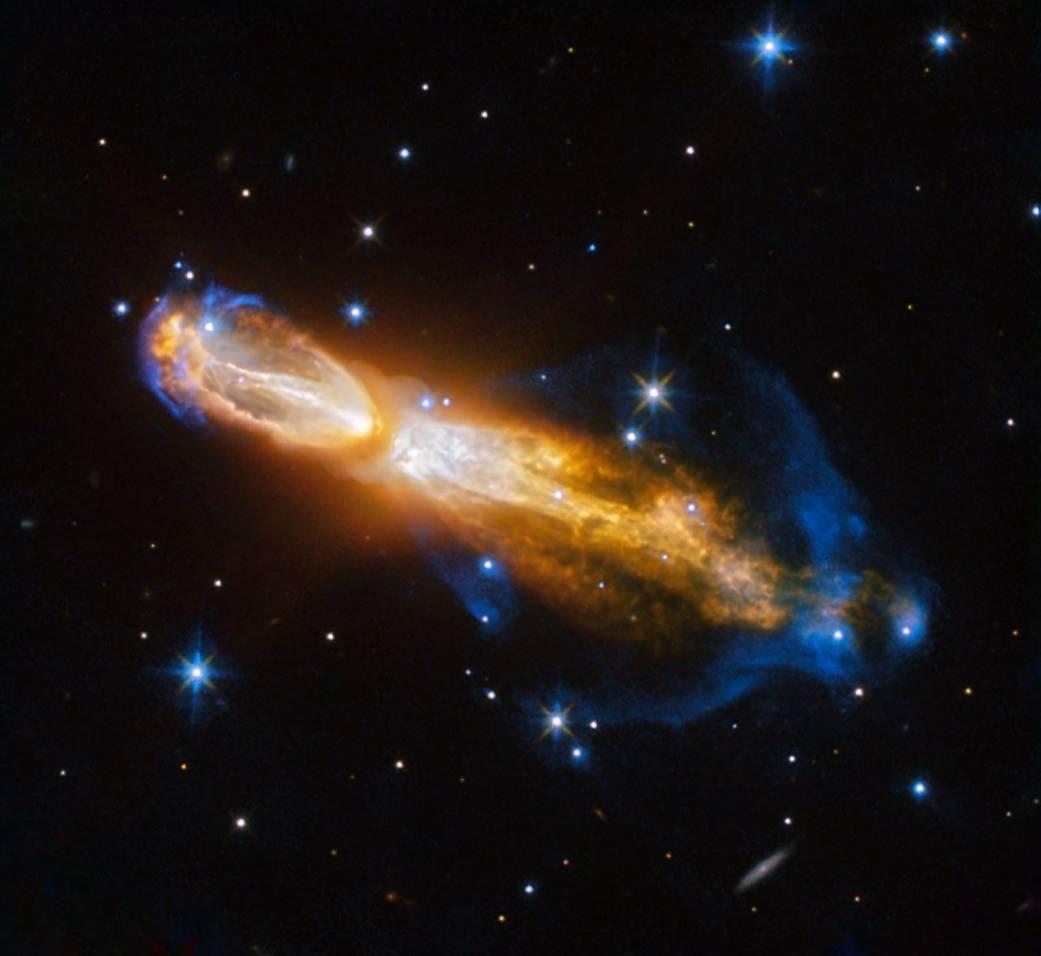
Imagine a celestial fireworks display, a dying star putting on its final, spectacular show. That’s precisely what the Hubble Space Telescope has captured with the Calabash Nebula, also known by its rather scientific moniker, OH 231.8+04.2. This isn’t just another pretty picture; it’s a snapshot of a profound moment in the universe – the dramatic, rapid transformation of a Sun-like star as it sheds its outer layers.
Think of it as a star’s dramatic exit, evolving from a bloated red giant into the ethereal beauty of a planetary nebula. The material being ejected isn’t just drifting away; it’s being expelled with incredible force, at speeds nearing a million kilometers per hour. Those vibrant yellow hues you see? That’s gas screaming outwards. Astronomers are thrilled to catch a glimpse of this phase because, in cosmic timescales, it’s fleeting – a brief, brilliant interlude before the nebula settles into its more mature, recognizable form over the next thousand years.
Now, you might be wondering about the nickname “Rotten Egg Nebula.” It’s earned, thanks to the significant presence of sulfur, which, as you can probably guess, gives off a rather unpleasant odor when combined with other elements. Fortunately for our noses, this cosmic aroma is emanating from over 5,000 light-years away in the constellation Puppis.
***
### A Glimpse Through Years of Cosmic Dust and Dedication
Seeing images like the Calabash Nebula always brings a unique sense of awe, coupled with a profound appreciation for the engineering and science behind capturing such profound cosmic events. For me, these celestial spectacles evoke a different kind of reflection. It’s a reminder of the intricate dance between immense natural forces and our own meticulous efforts to understand them.
When I look at the vibrant, dynamic structures within this nebula, I can’t help but think about the delicate balance of materials and processes that make our own endeavors in space possible. The sheer energy involved in a star’s demise, the incredible speeds, the raw composition of ejected elements – it’s all a testament to the power of physics and chemistry at their grandest scale. My past work involved grappling with these fundamental principles, but on a much smaller, yet equally critical, scale. It was about understanding how materials behave under extreme conditions, how they react, how they degrade, and how to ensure they maintain their integrity, no matter the environment.
This image, with its swirling gases and intense velocities, also highlights the transient nature of cosmic phenomena. Stars don’t linger in such dramatic phases. They evolve. This rapid change, this “blink of an eye” in astronomical terms, underscores the importance of timely observation and precise data collection. It’s a principle that resonates deeply with the demands of space exploration, where every second, every measurement, is crucial. There’s no room for error when you’re operating in an environment where failures can be catastrophic. The systems we build, the materials we select, must withstand unimaginable stresses, both thermal and mechanical.
Even from my current vantage point, with my days filled with a different kind of demanding, albeit infinitely rewarding, work, the lessons learned from my time in the industry remain. The core understanding of how things are built, how they function, and the paramount importance of safety, even in the face of mind-boggling forces, is a perspective that never truly leaves you. It’s about appreciating the fundamental building blocks, whether they’re in a star’s outer shell or the components of a spacecraft, and recognizing the meticulous care required to harness or simply observe them.
Leave a Reply