### The Silent Watcher: A Dish, a Galaxy, and the Echoes of Ingenuity
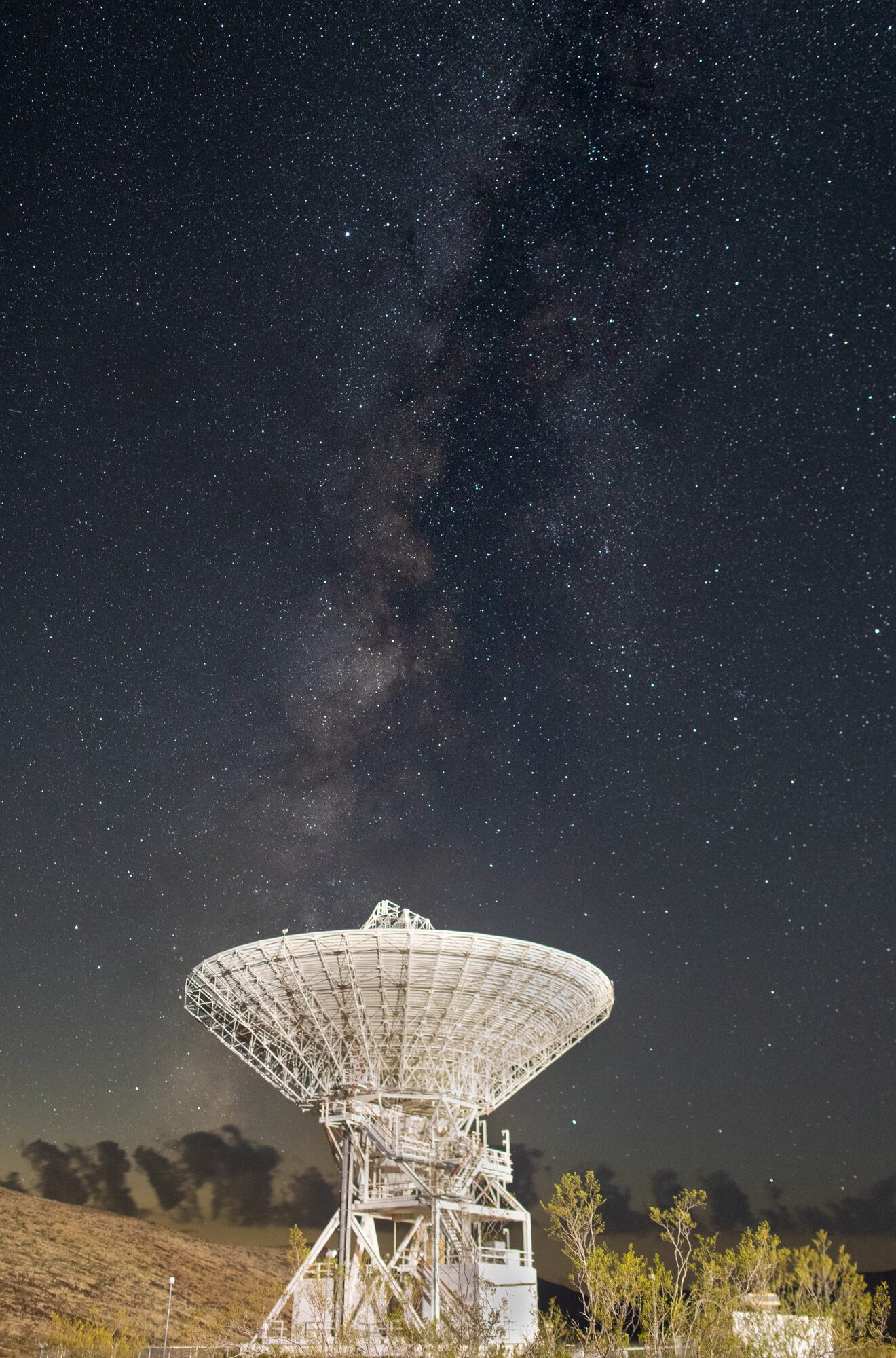
Imagine a colossal ear, turned perpetually towards the cosmos, straining to capture the faintest whispers from across the void. That’s the image presented by Deep Space Station 15 (DSS-15) at NASA’s Goldstone Deep Space Communications Complex. This isn’t just a piece of terrestrial machinery; it’s a crucial node in humanity’s interstellar conversation, tasked with listening to the distant hums of our robotic emissaries exploring the solar system and beyond. In this striking photograph, taken in September 2025, DSS-15 stands sentinel against the breathtaking tapestry of the Milky Way, a stark reminder of our humble place in the grand cosmic dance.
***
## From the Shuttle’s Forge to the Backyard Watchtower
There’s a certain kind of magic in witnessing humanity reach for the stars, isn’t there? Even from my current vantage point, juggling school lunches and soccer practices, I can’t help but feel a thrill when I see images like this. That giant dish, DSS-15, with the Milky Way swirling above – it’s a powerful symbol, and for me, it resonates on a deeply personal level.
Working with materials and understanding the unforgiving physics of space was once my daily bread. The sheer ingenuity required to build something that can withstand the vacuum, the radiation, the extreme temperature swings – it’s a constant marvel. When I was in the thick of it, my focus was on the micro-level: the atomic bonds in a thermal protection tile, the precise alloy composition for a critical structural component, the stringent testing protocols to ensure absolute safety. Every weld, every bolt, every coating was a testament to countless hours of meticulous design and rigorous analysis. We were building to keep brave souls alive in the most hostile environment imaginable.
The Space Shuttle, that magnificent workhorse, was a symphony of these material challenges. From the delicate dance of re-entry heat shields to the robust engineering of the solid rocket boosters, every part had to perform flawlessly. The lessons learned in those years about material science, stress tolerances, and the absolute necessity of redundancy are etched into my understanding of how we interact with space. It’s a mindset that never truly leaves you.
Now, watching from the sidelines, my perspective has broadened, much like the view from orbit. I see the bigger picture. This DSS-15 dish, for instance. It’s not just about the metal it’s made from, or the electronics that power it. It’s about the *communication*. It’s about the data flowing back from Voyager, from Mars rovers, from probes venturing into the outer reaches. It’s the echo of our curiosity, transmitted across unimaginable distances.
My experience taught me that every mission, whether it’s launching a shuttle or receiving a signal from billions of miles away, is built on a foundation of incredible engineering and an unwavering commitment to pushing the boundaries of what’s possible. The materials might be different, the challenges specific to deep space rather than orbital flight, but the underlying principle of audacious, meticulous, and *safe* exploration remains the same.
Seeing DSS-15 framed against the Milky Way is a reminder that even though my daily focus has shifted to the terrestrial (and remarkably, wonderfully chaotic) world of children, the spirit of exploration, and the incredible human achievement it represents, continues to captivate me. It’s a quiet awe, a knowing appreciation for the intricate tapestry of technology and ambition that allows us to not only build machines that fly to space but also to listen to the stories the universe has to tell. It’s a different kind of watching, perhaps, but no less invested.
Leave a Reply