## The Fleeting Crimson Ghosts of the Upper Atmosphere
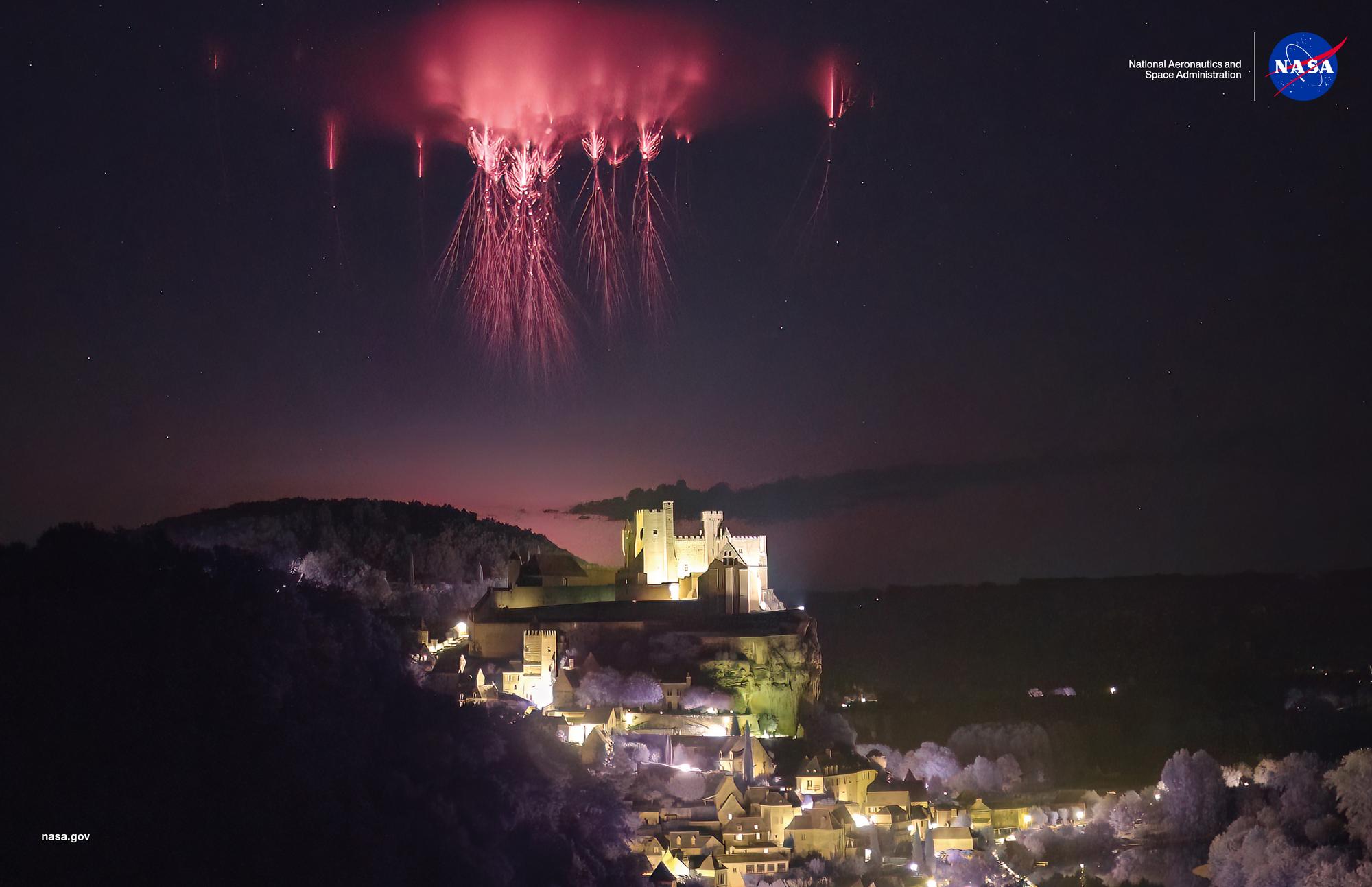
Imagine a lightning strike, a violent release of energy from the depths of a storm cloud. Now, picture something far more ethereal, a fleeting crimson glow dancing *above* that tempest. These are sprites, and witnessing one is a rare and wondrous event. NASA’s recent capture of these enigmatic electrical phenomena over the Château de Beynac is a breathtaking glimpse into a corner of our atmosphere we’re only just beginning to understand.
For a few precious milliseconds, these incandescent figures, often described as looking like jellyfish or even carrots, illuminate the mesosphere. They are not related to the familiar lightning we see ground-level but are instead a form of “gigantic jet” – a type of lightning that travels upwards from the storm cloud into the ionosphere. The exact mechanisms that create sprites are still a subject of intense scientific inquiry, but they are believed to be triggered by the intense positive lightning strikes that occur below. The resulting electrical discharge in the upper atmosphere ionizes the air, causing it to glow with that signature reddish hue.
The photograph, taken by NASA, is a testament to the power of both nature’s most dramatic displays and our persistent human drive to observe and document them. It reminds us that even in the skies directly above us, there are still mysteries waiting to be unveiled.
—
## From Shuttle Mechanics to Sprite Spectacles: Seeing the Unseen
The sky above a raging thunderstorm isn’t just a canvas for lightning. It’s also home to ephemeral, crimson ghosts – sprites. Seeing one is like catching a whisper from the upper atmosphere, a fleeting moment of wonder. And while I might be trading launch pads for playdates these days, my mind still often drifts to the atmospheric ballet I once helped orchestrate.
My years immersed in the intricate dance of materials, processing, and the unwavering pursuit of safety, particularly during the Space Shuttle era, have fundamentally shaped how I perceive these natural phenomena. When I look at images like the one NASA recently released of sprites over Château de Beynac, it’s not just a beautiful picture; it’s a cascade of memories and ingrained analytical processes.
Think about the sheer precision required to build and launch something as complex as the Space Shuttle. Every material had to withstand extreme temperatures, pressures, and stresses. We were constantly interrogating how things would behave, how they would react, and crucially, how we could ensure they wouldn’t fail. This involved a deep dive into the fundamental physics and chemistry of everything from the heat shield tiles to the smallest bolt. We learned to anticipate the unexpected, to build in redundancies, and to understand the critical thresholds of failure.
This mindset, honed by countless hours spent scrutinizing material properties and potential failure modes, translates surprisingly well to observing natural events like sprites. When I see that crimson glow, my mind immediately goes to the energy dynamics involved. What are the atmospheric conditions that allow for such an electrical discharge? What are the ionization processes at play? It’s a different scale, a different set of variables, but the core analytical approach remains: understand the forces, the materials (in this case, ionized air), and the resulting phenomena.
My background instilled in me a profound respect for the delicate balance of forces that govern our universe, both the engineered and the natural. The Space Shuttle missions were a testament to human ingenuity in overcoming immense challenges to explore the cosmos. Now, my focus has shifted to nurturing my own burgeoning astronauts here on Earth. Yet, that deep-seated need to observe, to understand, and to ensure safety – principles that were paramount in my previous life – still drives my fascination with the world around me. Seeing those sprites isn’t just a beautiful sight; it’s a reminder of the vast, intricate systems at play, systems that, in their own way, demand our careful observation and appreciation. It’s about seeing the unseen, the incredible phenomena happening right above our heads, and appreciating the complex interplay of forces that make it all possible.
Leave a Reply