## A Cosmic Ballet and the Quiet Observation of the Universe
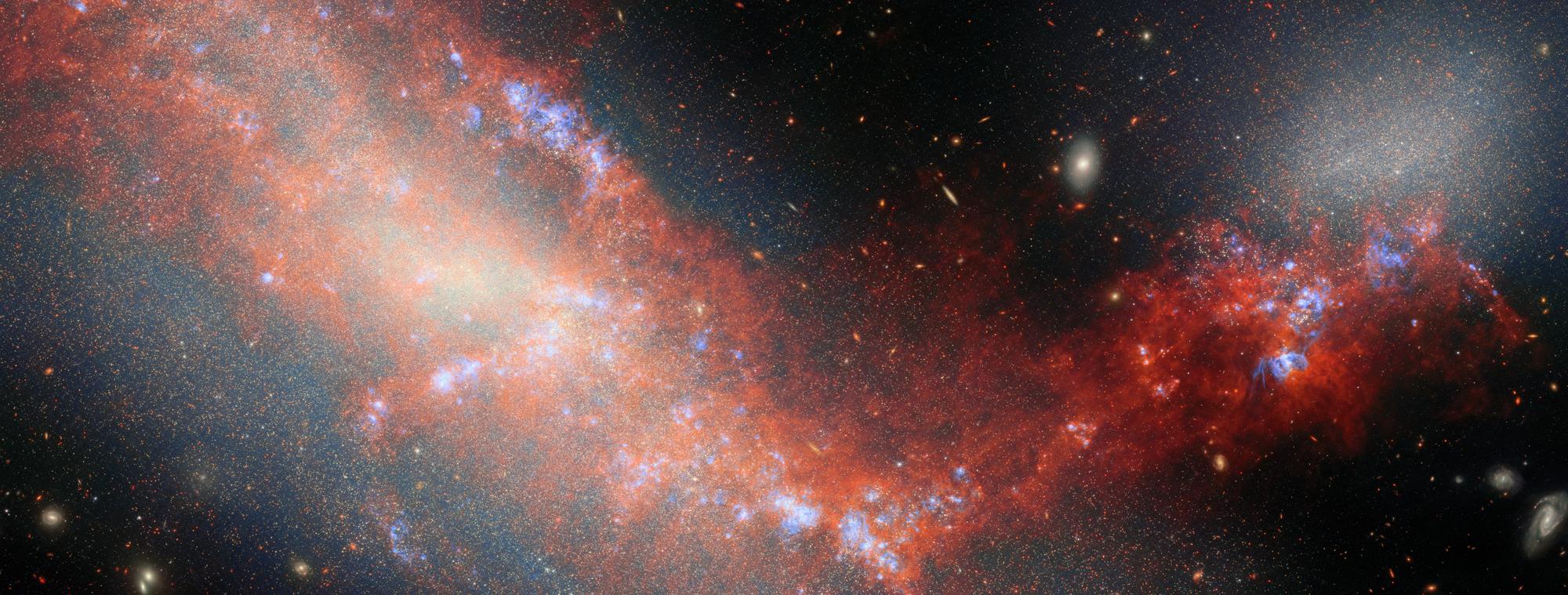
The universe, in its boundless expanse, offers us breathtaking spectacles. Imagine two colossal celestial bodies, NGC 4490 and NGC 4485, locked in a gravitational waltz approximately 24 million light-years distant, within the constellation Canes Venatici. This isn’t just any galactic pairing; it’s the closest observed instance of dwarf galaxies in such an intimate, star-resolving embrace. Their interaction, a slow-motion collision and merger, paints a vivid picture of cosmic evolution, a testament to the dynamic forces shaping the cosmos. This image captures a moment in an eons-long dance, a snapshot of creation and transformation on an unimaginable scale.
***
## From Shuttle Thrusters to Toddler Tangles: A New Perspective on the Cosmos
You know, sometimes I look at images like this, of galaxies twirling together across unimaginable distances, and my mind flashes back to a different kind of ballet. It was a ballet of fire and metal, of precise engineering and immense forces. The Space Shuttle, that magnificent machine I had the privilege of working on, was a marvel of materials science and intricate processing. My years dedicated to ensuring every bolt, every thermal tile, every weld could withstand the brutal realities of launch and reentry have left an indelible mark on how I view the universe and our place within it.
Even now, with my days filled with the beautiful chaos of four young children, the analytical mind honed by a career in the space industry doesn’t quite switch off. It’s just… re-calibrated. Instead of scrutinizing the stress tolerances of an external tank or the thermal properties of a heat shield, I’m assessing the structural integrity of a block tower or the kinetic energy involved in a well-aimed stuffed animal projectile. It’s a different scale, to be sure, but the fundamental principles of understanding how things work, how they react under pressure, and how to ensure their safe operation, they’re still there.
When I see images of these distant galaxies, like NGC 4490 and NGC 4485, I don’t just see pretty pictures. My brain immediately starts to unpack the underlying physics, the sheer forces at play. I think about the materials that must comprise those stars, the extreme temperatures and pressures involved in their formation and interaction. It’s a constant hum in the background, a reminder of the incredible engineering that *is* the universe itself, operating on principles far grander than anything we’ve ever built.
My experience taught me to look for the details, the subtle indicators that tell a larger story. It taught me the importance of rigorous testing and the unforgiving nature of physics when safety is paramount. Now, while my “testing” involves ensuring no one breaks a bone (or a cherished toy), that same analytical lens is applied to the cosmos. I see the elegant solutions the universe has devised for survival and evolution, solutions that have been at play for billions of years.
It’s a unique position, this transition from the cutting edge of human technological achievement to the front lines of early childhood development. But the wonder hasn’t faded. If anything, it’s deepened. Observing the universe from a quiet corner of Earth, while simultaneously navigating the intricate universe of a growing family, offers a profound appreciation for both the grand cosmic dance and the equally complex, yet utterly vital, human one. And that, in its own way, feels like a mission of utmost importance.
Leave a Reply