## A Cosmic Catfight: When Hubble and Euclid Play Together
Imagine the universe as a grand stage, and the Cat’s Eye Nebula, NGC 6543, is putting on a truly spectacular show. Recently, NASA’s iconic Hubble Space Telescope and the newer, wider-eyed Euclid mission have collaborated to give us an unprecedented glimpse into this celestial marvel. It’s not just about pretty pictures; this joint effort is a testament to how different perspectives can unlock deeper secrets.
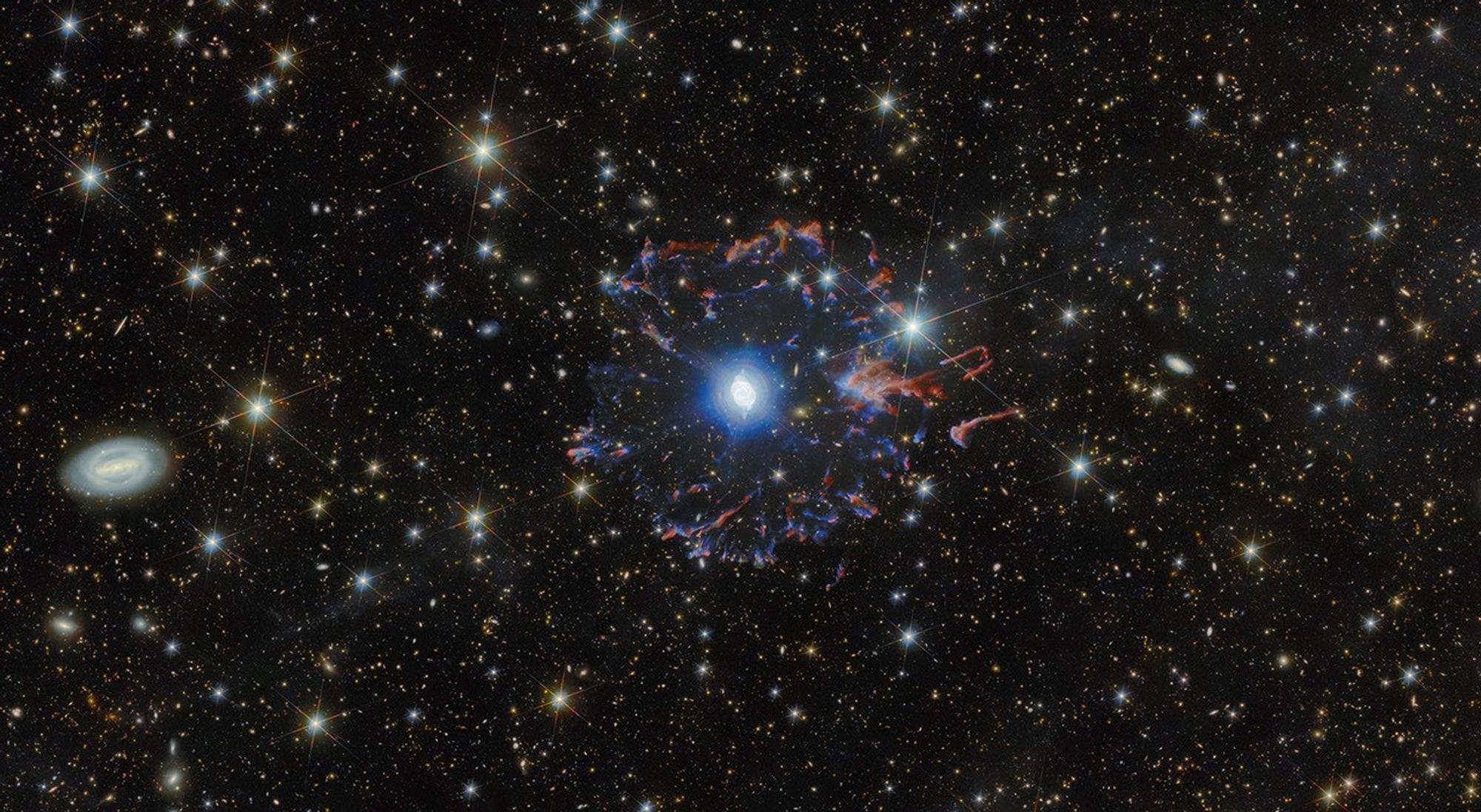
Euclid, with its broad view and sensitivity to near-infrared and visible light, has captured the nebula’s vibrant heart. It reveals the intricate arcs and filaments, not as isolated structures, but as part of a larger halo. This halo is composed of fragments of gas, dramatically flung outwards from the star in its earlier life, even before the more familiar central nebula began to take shape. Think of it as the lingering echoes of a cosmic birth.
Hubble, on the other hand, has focused its sharp gaze on the very core. Its high-resolution visible-light images dive deep into the billowing gas, providing an astonishing level of detail right at the nebula’s center. Where Euclid gives us the sweeping panorama, Hubble offers the intimate portrait.
Together, these two incredible observatories have painted a richer, more nuanced picture of NGC 6543. We see the intricate dance of stellar evolution – the dramatic expulsion of gas as a star reaches the end of its life – set against the backdrop of countless distant galaxies. It’s a powerful reminder that even our local cosmic neighborhood exists within the vastness of the universe, and that modern astronomical surveys allow us to appreciate both simultaneously. This collaboration between Hubble and Euclid isn’t just about observing; it’s about understanding the delicate interplay of cosmic forces, from the dying breath of a star to the grand tapestry of the cosmos.
—
## From Fiery Re-entry to Celestial Visions: A New Appreciation for the Cosmos
There’s something deeply profound about looking up at the night sky. Even with the whirl of everyday life, that vast expanse always manages to pull me in, offering a sense of perspective that’s hard to find elsewhere. Lately, my gaze has been drawn to the incredible images coming from our space telescopes, particularly the recent joint effort between Hubble and Euclid on the Cat’s Eye Nebula.
It’s fascinating to see how these instruments, with their distinct strengths, can work in tandem to reveal more than either could alone. Euclid’s wide, all-encompassing view, capturing the subtle infrared whispers and broad visible light sweep, gives us the grander narrative. It’s like seeing the entire story unfold, from the outward-flung fragments of an earlier ejection to the larger halo surrounding the nebula’s core. This perspective allows us to appreciate the full timeline, the lingering evidence of past stellar drama.
Then there’s Hubble. Its legacy is undeniable, and its ability to zoom in, to capture that exquisite, high-resolution detail in the visible light spectrum, is a marvel. It’s where the intimate moments are revealed, the intricate tendrils of gas swirling in the nebula’s heart. This is where you can truly get lost in the artistry of space.
Observing these combined images, I can’t help but reflect on the importance of complementary data. When you’re working on complex systems, especially those that push the boundaries of engineering and human endurance, understanding the full picture is paramount. You learn that even the most robust design can have subtle vulnerabilities, and that rigorous analysis from multiple angles is key to ensuring success and, most importantly, safety. A single sensor reading, a solitary observation, might tell a part of the story, but it’s the synthesis of diverse inputs that truly illuminates the truth.
These missions, working together to unravel the secrets of a nebula, remind me of that principle. The delicate interplay between a star’s dramatic end and the vast cosmic background, as captured by these telescopes, is a beautiful illustration of how interconnected everything is. It’s a reminder that even in the most monumental endeavors, attention to the finest details, coupled with a broad, encompassing view, is what leads to true understanding. And as I navigate the delightful chaos of a household filled with four wonderful children, I find that same principle applies – the grand vision of raising a family is built on countless individual moments, each requiring a different kind of focus and appreciation. The universe, it seems, is full of lessons, no matter where you’re looking.
Leave a Reply