Here’s a summary and a blog post from the perspective of an ex-Space Shuttle Materials and Processing engineer turned stay-at-home mom, focusing on the provided image and its implications:
## Summary:
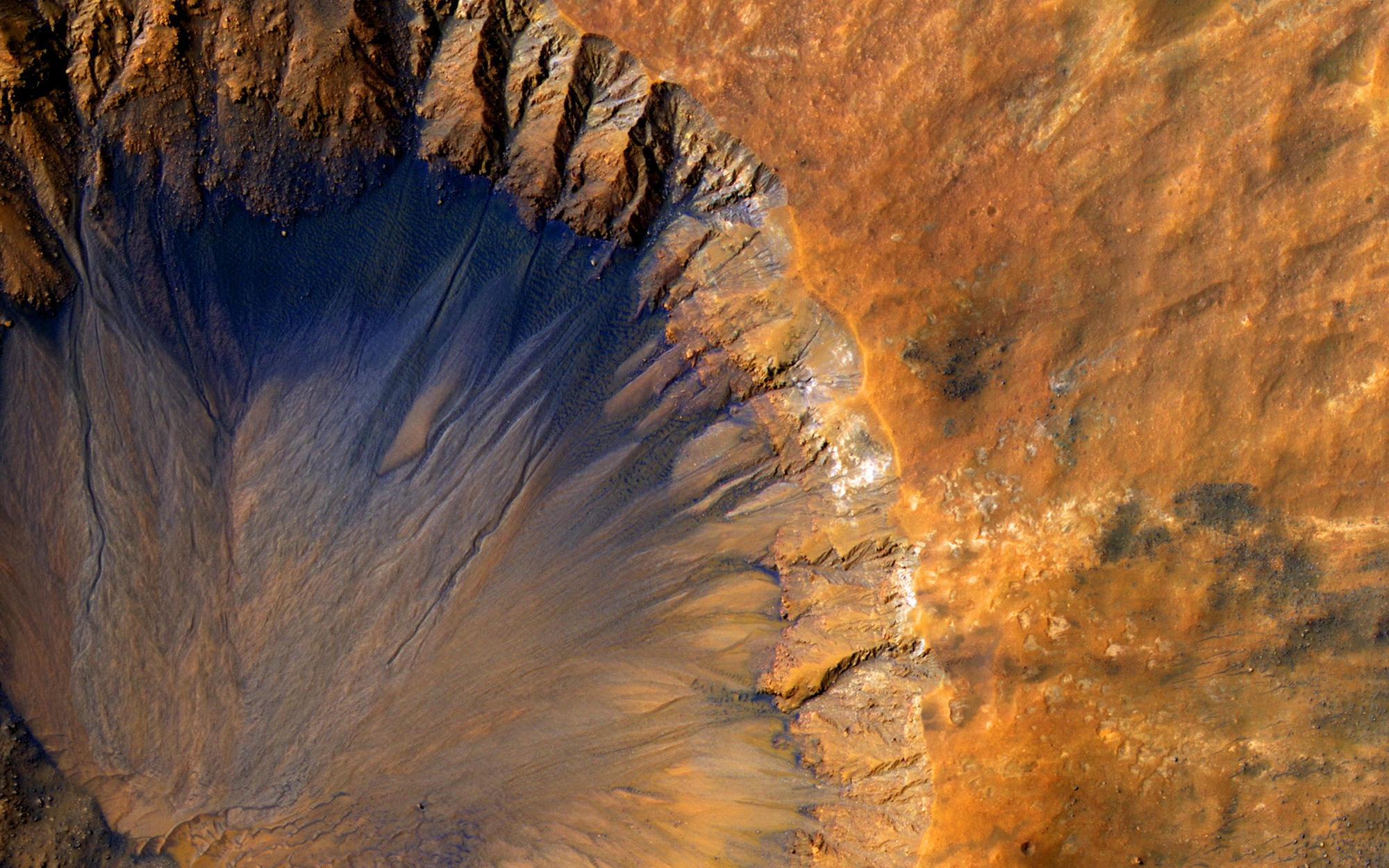
A crisp, remarkably preserved impact crater on Mars, captured by the Mars Reconnaissance Orbiter, offers a stunning glimpse into geological events that unfolded relatively recently on the Red Planet. The sharp rim and intact ejecta blanket suggest a young crater, a stark contrast to the billions of years of cosmic bombardment that have weathered many Martian features. This visual evidence fuels ongoing scientific inquiry into the dynamic history and potential for change on Mars.
—
## Blog Post: Martian Scars and the Whispers of Time
There’s a particular kind of beauty in the stark, almost untouched landscapes of other worlds. Seeing images like this one, a crater on Mars that looks like it was formed yesterday, always sends a shiver down my spine. It’s not just the visual spectacle, though that’s undeniably breathtaking. It’s the story it tells, or rather, the stories it *could* tell.
When you spend years immersed in the intricate dance of bringing something as complex as a spacecraft from concept to orbit, you develop a certain way of looking at things. You see the underlying structure, the potential failure points, and the incredible resilience built into every component. For me, that meant pouring over material specifications, understanding how alloys would behave under extreme thermal cycles, and meticulously documenting processes to ensure everything held together against the unforgiving vacuum and radiation of space.
Looking at this Martian crater, I’m immediately struck by its crispness. The rim is sharp, the ejecta – the debris thrown out by the impact – is still clearly defined, not yet smoothed by eons of dust storms or minuscule impacts. This isn’t a gentle, weathered feature; it’s a fresh wound on the Martian surface. This visual clarity, this lack of significant erosion, tells us that the geological processes shaping Mars might be more active, or at least more recent, than we sometimes assume for some regions.
It’s a subtle reminder of the immense power of cosmic events. We’re used to thinking of Earth’s craters as ancient history, often obscured by our planet’s dynamic geology. But on Mars, with its thinner atmosphere and less active plate tectonics, these impacts can persist for much longer, acting as raw, unfettered records of the solar system’s history.
This image, even though it’s from a mission I didn’t directly work on, resonates deeply. It speaks to the same fundamental principles of engineering and science: observation, analysis, and the relentless pursuit of understanding. Even from my current vantage point, surrounded by the delightful chaos of four children, my mind still gravitates towards the elegance of these distant worlds and the meticulous work that makes exploring them possible. This crater isn’t just a geological formation; it’s a testament to the universe’s ongoing narrative, a story captured and sent back to us, waiting for us to decipher. And that, to me, is a profound kind of magic.
Leave a Reply