### The Ghosts of Impacts Past: What a Martian Crater Teaches Us About Space
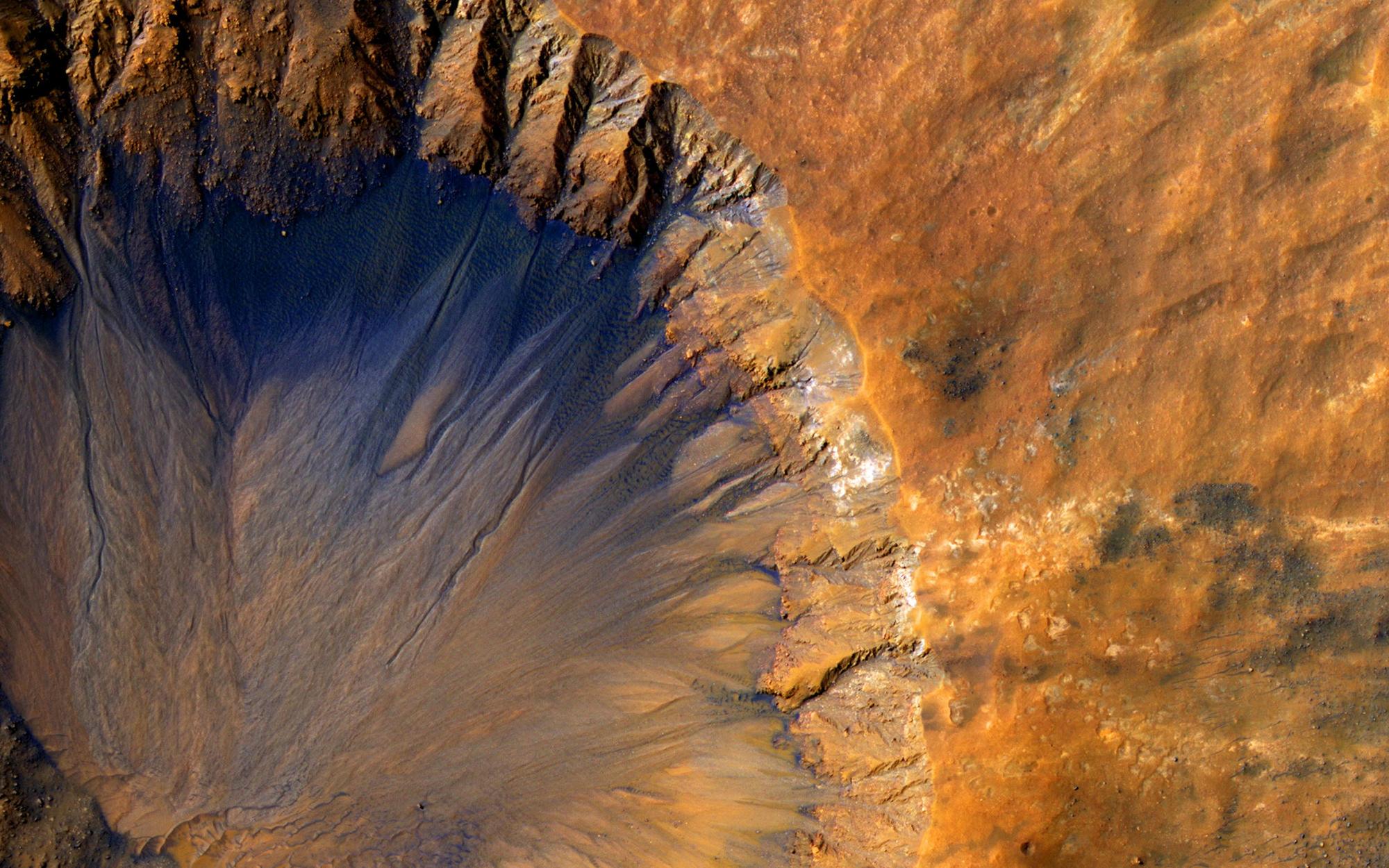
Looking at this image, a stark, dark circle on the dusty red surface of Mars, it’s easy to get lost in the sheer otherworldliness of it all. But for me, this isn’t just a pretty picture from a faraway planet. It’s a stark reminder of the relentless forces shaping not just celestial bodies, but the very fabric of the universe we explore. This particular impact crater, captured by NASA’s Mars Reconnaissance Orbiter in 2015, whispers tales of cosmic violence and geological time. Its sharp rim and the scattered, almost pristine ejecta tell a story of a relatively recent event, a cosmic “ouch” that left its mark in the Martian soil.
***
## From the Launchpad to the Playground: A Different Kind of Orbital Mechanics
It’s funny, the things that stick with you. After years spent wrestling with the physics of lifting tons of metal and fuel into the unforgiving vacuum of space, you’d think my mind would be permanently calibrated to rocket equations and thermal blankets. And in many ways, it is. But life has a way of recalibrating your perspective, doesn’t it?
Now, my daily orbit involves navigating the chaotic trajectories of four small humans, their demands for snacks creating gravitational pulls I never quite anticipated. Yet, strangely, the lessons learned in meticulously engineering the Space Shuttle feel remarkably… applicable.
When I think about this image of a Martian impact crater, it’s not just the scientific marvel that captures my attention. It’s the **integrity of the structure**. That sharp rim, the well-defined ejecta – these are indicators of a relatively fresh event. In my previous life, understanding the integrity of materials under extreme stress was paramount. We spent countless hours analyzing how metals and composites would behave under the immense forces of launch, the searing heat of re-entry, or the chilling emptiness of orbit. We had to ensure that every component, from the smallest bolt to the largest wing segment, would maintain its structural soundness, its ability to perform its designated function flawlessly.
Looking at this crater, I see a similar principle at play. The Martian surface, in this instance, has held up remarkably well. It hasn’t eroded significantly, it hasn’t been buried by aeons of dust storms in a way that would obscure the details. This tells us something about the **stability of the Martian environment**, at least in this particular region and over the timeframe implied by the crater’s preservation. It speaks to the resilience of planetary surfaces, a concept we grappled with constantly. We weren’t just building a vehicle; we were building something that had to *survive*. We had to anticipate all the potential ways it could degrade, fail, or be compromised, and engineer against them.
My experience has honed a certain… **observational rigor**. It’s a habit of looking beyond the surface, of seeking out the subtle clues that reveal deeper truths. When analyzing a stress fracture in a thermal protection tile, or the composition of a new alloy, you learn to scrutinize. You look for anomalies, for deviations from the expected. This same meticulous attention to detail is what makes an image like this so fascinating. The clarity of the ejecta blanket, the distinctness of the crater walls – these aren’t just visual features; they are data points. They speak to the forces at play, the speed of the impact, and the subsequent environmental conditions.
Even now, as I monitor the goings-on in the space industry from the sidelines, I find myself drawn to these kinds of images. They are a tangible link to a past I cherish, a reminder of the incredible ingenuity and perseverance that defines space exploration. And while my current focus is on mastering the art of the bedtime story and the strategic deployment of snacks, that ingrained understanding of materials, processes, and the critical importance of structural integrity – of ensuring things don’t just *look* right, but *are* right – continues to inform how I see the universe, one celestial crater at a time. It’s a different kind of orbital mechanics, perhaps, but the underlying principles of observation, analysis, and a deep respect for the forces at play remain the same.
Leave a Reply