## The Little Things That Make the Universe Go ‘Round (and ‘Round, and ‘Round in Space!)
Ever watched a marble roll across the floor? It’s a simple act, governed by familiar physics – gravity pulling it down, friction slowing it. But what happens when you take away the gravity? When you remove those everyday influences that dictate how things behave down here? That’s where things get *really* interesting, and it’s a question that has fascinated me for years.
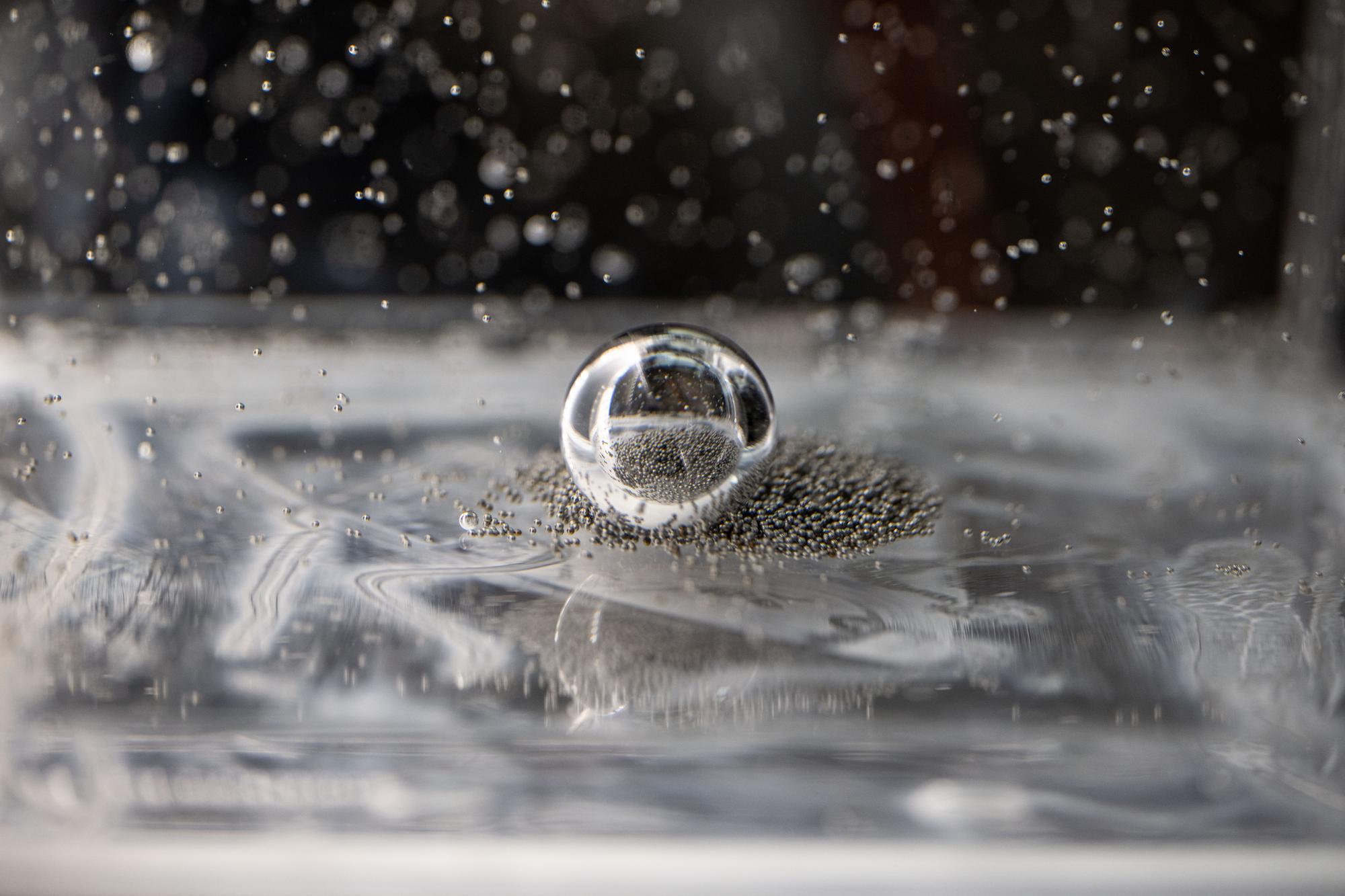
Recently, I stumbled upon a remarkable image from NASA: a cluster of tiny ball bearings surrounding a larger one, suspended as if by magic in the void. This isn’t just a pretty picture; it’s a snapshot from the “Fluid Particles” experiment aboard the International Space Station (ISS). Conducted within the sophisticated Microgravity Science Glovebox, this experiment delves into the fundamental physics of how particles interact when the constant tug of Earth’s gravity is removed.
From my vantage point, observing these experiments from the ground now, this image sparks a deep appreciation for the meticulous work that goes into understanding even the most basic phenomena in an entirely alien environment. Thinking about how these tiny spheres behave without gravity reminds me of the complex material interactions I used to scrutinize. We’d spend countless hours analyzing how different metals, ceramics, and composites behaved under extreme conditions – temperature fluctuations, radiation, and the ever-present challenge of making sure everything stayed together reliably.
The way these ball bearings arrange themselves, the forces at play between them – it all harks back to a foundational understanding of physical properties. Even something as seemingly straightforward as how a solid particle interacts with another is profoundly altered in microgravity. Understanding these nuances isn’t just academic curiosity; it’s crucial for designing everything from new manufacturing techniques in space to the very habitats astronauts will live in.
My past work involved a deep dive into the *how* and *why* behind material behavior, particularly focusing on ensuring safety and functionality in an environment that is inherently hostile. This often meant thinking about the smallest possible scale – the atomic bonds, the surface energies, the way particles would cohere or disperse. Seeing this image, I can’t help but connect it to those past challenges. The principles are the same, even if the scale and the specific application are different. It highlights that even seemingly simple experiments in space are built upon a bedrock of rigorous scientific inquiry and a deep understanding of material properties and interactions – the same kind of understanding that ensures the integrity of every component launched into orbit.
This glimpse into the “Fluid Particles” experiment is a beautiful reminder that even in the vastness of space, it’s often the little things, the seemingly insignificant particles, that hold the keys to unlocking some of the universe’s greatest mysteries. And for those of us who’ve dedicated time to understanding those mechanics, observing them from afar offers a unique perspective, blending past experiences with a continued fascination for what lies beyond our atmosphere.
Leave a Reply