## A Universe Painted in Infrared: SPHEREx Unveils the Cosmos in a New Light
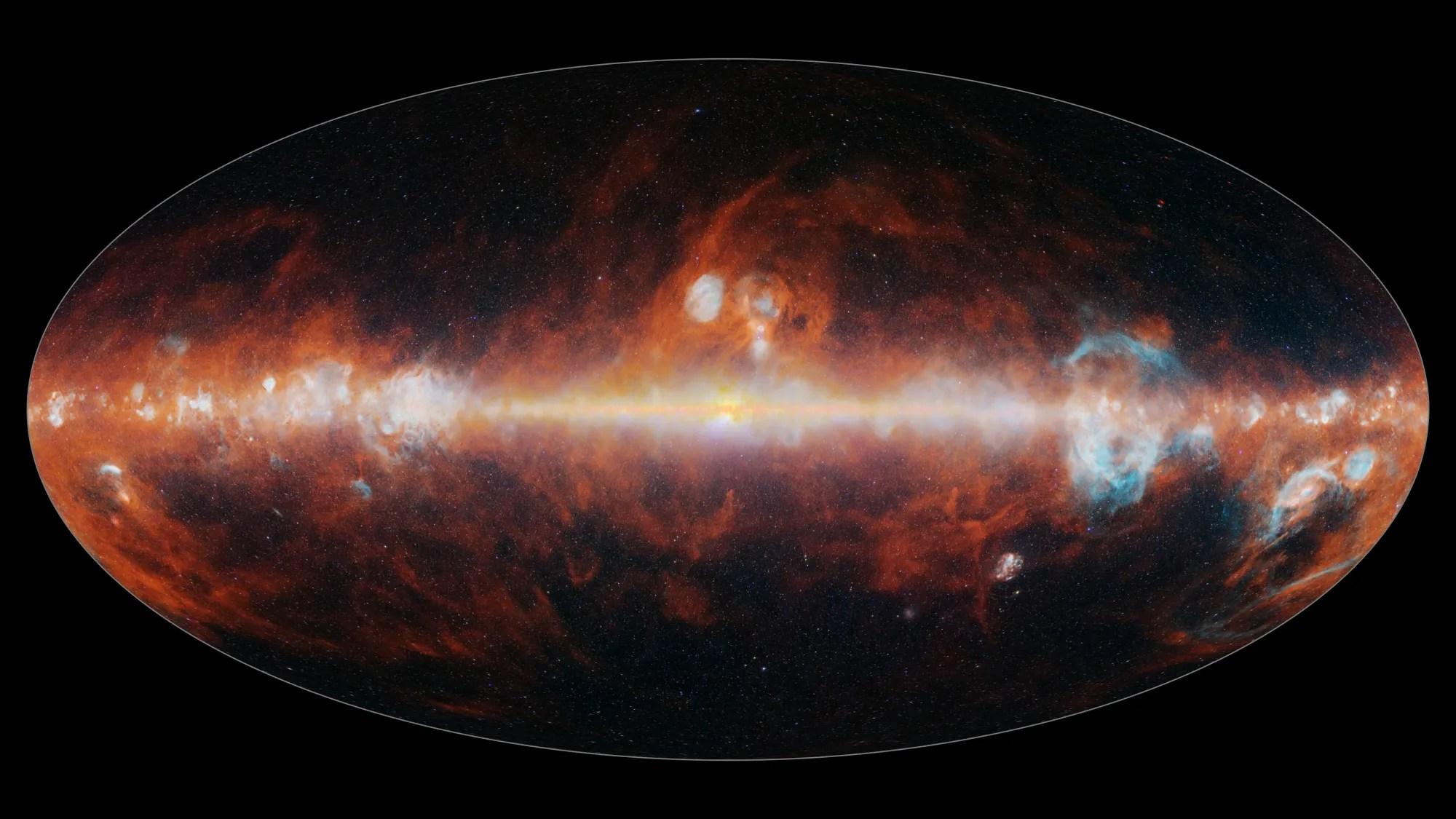
Imagine the night sky, not as a scattering of distant diamonds, but as a vibrant, swirling canvas of colors we’ve never truly seen. That’s the breathtaking reality NASA’s upcoming SPHEREx observatory promises to deliver. This isn’t just another telescope; it’s a cosmic cartographer, set to map the *entire* sky in an unprecedented 102 infrared colors. Released on December 18, 2025, the image above is our first tantalizing glimpse of what SPHEREx will reveal. We see the fiery blush of cosmic dust, the cool, ethereal glow of hot hydrogen gas, and the brilliant hues of stars, all captured in a spectral language our eyes can only begin to comprehend. This groundbreaking mission is poised to unlock secrets of galaxy formation, the origins of our universe, and perhaps even the ingredients for life itself.
—
## From the Launch Pad to the Living Room: Seeing the Universe Anew
It’s funny, isn’t it? For years, my days were filled with the hum of machinery, the sharp scent of specialized lubricants, and the intense focus on the smallest details of materials that had to withstand the unimaginable forces of launch and the unforgiving vacuum of space. The Space Shuttle era, especially the years I spent immersed in its intricate world of alloys, composites, and safety protocols, taught me a profound respect for precision and the sheer ingenuity required to push the boundaries of what’s possible. Even now, with my world revolving around scraped knees, bedtime stories, and the endless delightful chaos of raising four children, that ingrained analytical mindset and deep appreciation for scientific endeavor remain.
When I see an image like the first sky map from NASA’s SPHEREx observatory, it’s more than just a pretty picture. It’s a reminder of the relentless curiosity that drives us to explore, and it triggers a cascade of thoughts informed by my past.
The release of this SPHEREx image, showcasing the entire sky mapped in 102 infrared colors, is nothing short of astounding. My mind immediately goes to the immense challenge of data acquisition and processing. Think about it: every single point of light, every wisp of gas, every speck of dust across the *entire* celestial sphere, being meticulously cataloged and analyzed across such a broad spectrum. It’s an engineering feat of staggering proportions, one that demands absolute reliability from every component.
During my time working on the Shuttle, safety and material integrity were paramount. We agonized over every weld, every bolt, every thermal protection tile. A failure, no matter how small, could have catastrophic consequences. This SPHEREx mission, while in a different domain, faces a similar, albeit different, set of critical considerations. The sensors, the optics, the data transmission systems – they all need to perform flawlessly for extended periods, far beyond human reach. This level of precision in observation, this ability to perceive the universe in wavelengths our own eyes can’t detect, is a testament to decades of innovation, building upon the very foundations that allowed us to send humans and complex machinery into orbit for years.
The image itself is a masterpiece of scientific visualization. The colors – the blues and greens from stars and hot hydrogen gas, the reds from cosmic dust – are not merely aesthetic. They are data made visible. This is where my experience with materials processing comes into play. Understanding how different elements and compounds interact with energy, how they absorb and emit light, is fundamental. SPHEREx is essentially analyzing the chemical composition and physical state of celestial objects by looking at their infrared “fingerprints.” This isn’t unlike analyzing the spectral signature of a material to understand its properties, albeit on a cosmic scale.
And then there’s the sheer scope. Mapping the *entire* sky. It’s a project that demands not just technological prowess but also a long-term vision. It speaks to a commitment to fundamental science, to understanding our place in the universe. While I may be knee-deep in LEGO bricks and juice boxes most days, the thrill of these scientific leaps resonates deeply. It reminds me that the spirit of exploration, the drive to understand what lies beyond, is a thread that connects us all, from the engineers meticulously crafting spacecraft to the families gazing up at the stars, wondering. SPHEREx is opening a new chapter in our cosmic understanding, and it’s a beautiful thing to witness, even from the ground.
Leave a Reply