## A Cosmic Crystal Shower: What Webb’s Latest Discovery Means for Our Understanding of Star Birth
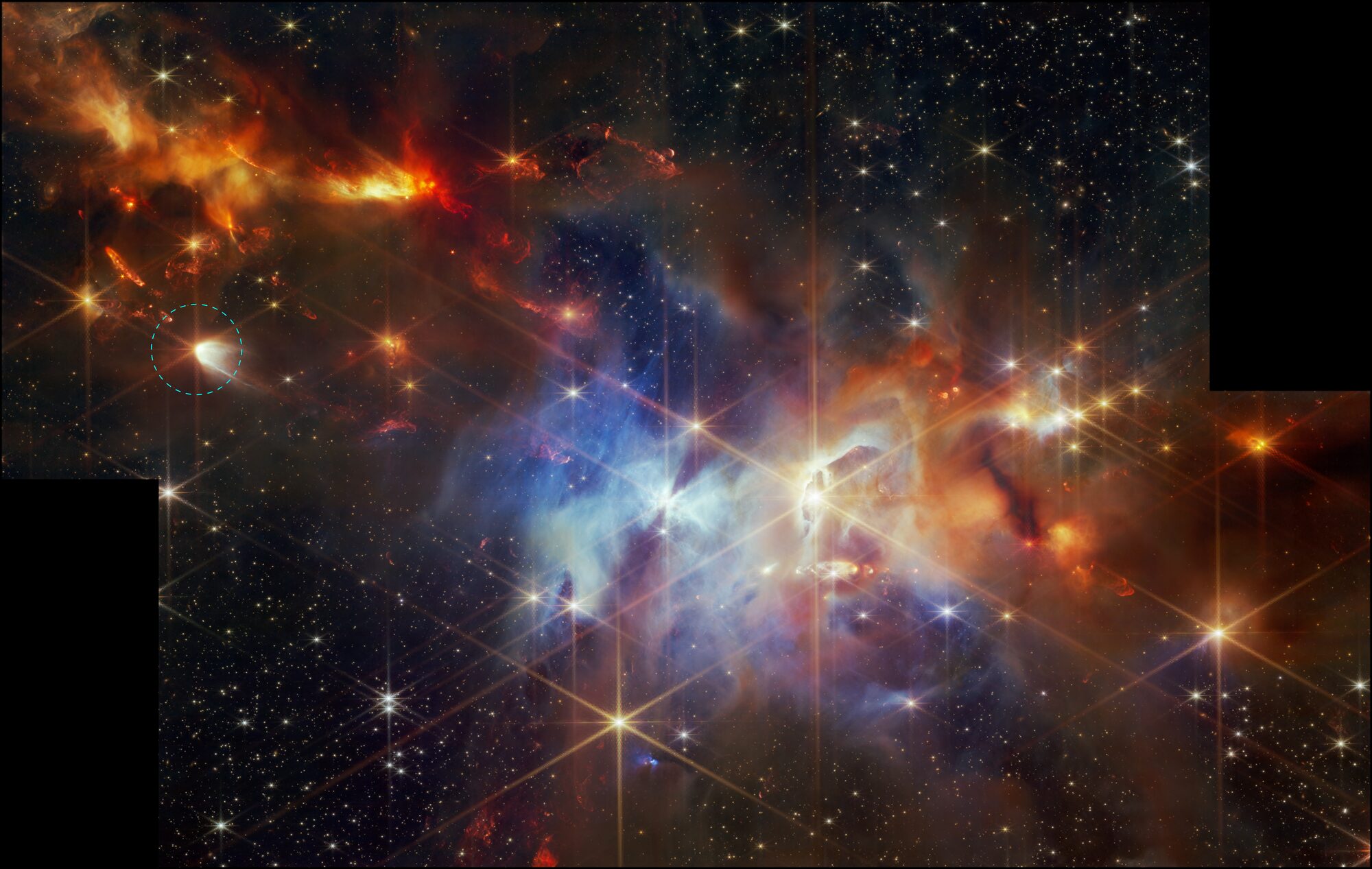
Imagine a celestial forge, not of iron and steel, but of stardust and gas, hotter than anything we can comprehend. Within this inferno, a young star, a protostar named EC 53, is taking its first breaths. And what a spectacle it’s putting on! NASA’s James Webb Space Telescope, with its unparalleled vision, has peered into the very heart of this nascent solar system and witnessed something truly astonishing: crystals forming and then being expelled outwards, like a cosmic crystal shower.
This isn’t just a pretty picture (though it is undeniably breathtaking). This discovery, made possible by Webb’s Mid-Infrared Instrument (MIRI), tells us something profound about the earliest stages of star and planet formation. For the first time, scientists have definitive proof that crystalline silicates – the same fundamental building blocks of rocky planets like our own Earth – are being forged in the searing inner disk of a protostar. What’s even more remarkable is the implication that these crystals aren’t just passively drifting; they’re being actively ejected, potentially carrying these vital ingredients to the outer reaches of the nascent system, the very places where planets will eventually coalesce.
For years, we’ve theorized about the complex processes happening in these stellar nurseries. We knew that dust and gas were the raw materials, but the precise conditions under which the first solid grains, let alone complex crystalline structures, would form have been a subject of much debate. Webb, by observing in infrared light, can pierce through the thick veils of dust that obscure these environments in visible light, giving us an unprecedented look at the chemistry and physics at play.
The MIRI instrument, with its ability to detect mid-infrared light, is crucial here. It can sense the distinct signatures of these silicate crystals, allowing researchers to confirm their presence and even glean information about their size and composition. The fact that these crystals are found in the hottest part of the disk and are seemingly being propelled outwards suggests an energetic process at work, perhaps driven by the young star’s intense radiation or powerful stellar winds.
This finding has significant implications for our understanding of how planetary systems, including our own, come to be. If crystalline silicates are abundant and readily transported to the outer disk, it means the ingredients for rocky planet formation are being seeded throughout the system from very early on. It paints a picture of a much more dynamic and efficient process than previously imagined, where the very building blocks of worlds are being actively distributed.
As we continue to analyze the data from Webb, we can expect many more revelations about the universe’s most hidden secrets. But for now, let’s marvel at this image of EC 53, a protostar throwing a cosmic crystal party. It’s a powerful reminder that even in the most extreme environments, the fundamental elements that will eventually form planets and perhaps life, are already hard at work.
Leave a Reply