## The Webb Telescope’s Cosmic Cranium: A Familiar Shape in an Unfamiliar Place
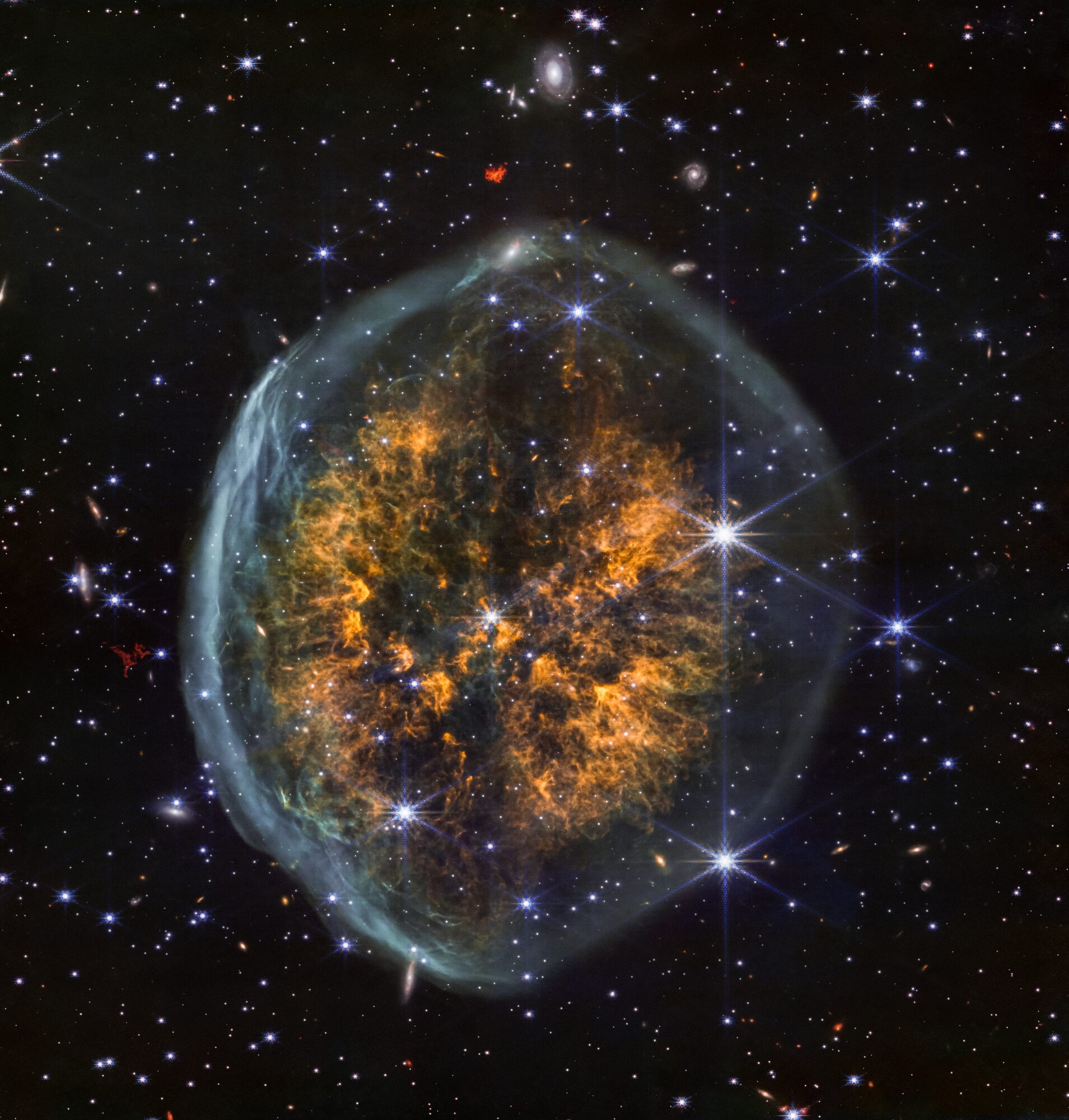
Ever gaze up at the night sky and feel a sense of awe at the sheer scale and mystery of it all? Now, imagine that feeling amplified a thousandfold, with a view so clear, so detailed, it feels like you’re peering into the very heart of creation. That’s precisely what the James Webb Space Telescope (JWST) is delivering, and its latest marvel, the Carina Nebula image, has a particularly striking feature that’s sparking both scientific interest and a touch of whimsical familiarity.
What appears, at first glance, uncannily like a celestial brain – complete with what some are calling “hemispheres” – is, in reality, the dramatic death throes of a star. This dying star is shedding its outer layers, creating a magnificent shell of gas. Within this ethereal envelope, we see a complex cloud of various elements, illuminated and sculpted by the star’s final breaths. It’s a stark, beautiful reminder of the life cycles of celestial bodies, a process that’s both destructive and, in its own way, generative.
This image, captured by the unparalleled sensitivity of Webb, isn’t just a pretty picture. It’s a treasure trove of data for astronomers. The intricate structures within the nebula allow scientists to study the composition and distribution of gas and dust, providing crucial insights into how stars form and evolve. The sheer detail visible in the Carina Nebula hints at processes that were previously hidden from our view, pushing the boundaries of our understanding of stellar nurseries and the raw materials that eventually coalesce into new worlds.
### A Glimpse Through the Lens of Experience
Observing this new image, I can’t help but be struck by the incredible advancements in our observational capabilities. It’s a far cry from the tools and techniques we relied on during my time intimately involved with the Space Shuttle program. Back then, our focus was on safely launching humans and payloads into orbit, on ensuring the structural integrity of everything we sent skyward, and on the meticulous processing of materials to withstand the extreme conditions of space.
The challenges were immense. We spent countless hours analyzing the properties of metals, ceramics, and composites, understanding how they would react to the vacuum, the radiation, and the extreme temperature swings. Every bolt, every weld, every surface coating was scrutinized with an engineer’s rigor, driven by the absolute imperative of safety. We were constantly building, testing, and iterating, pushing the envelope of what was possible to make those missions a reality.
Looking at the Webb telescope’s images, I see the culmination of decades of innovation. The materials science that enables such sophisticated instruments, the precision engineering that allows for such delicate observations – it all builds upon the foundational principles we grappled with. While my daily life now involves a different kind of intricate problem-solving (four children keep me very busy!), my understanding of how complex systems are designed, built, and tested from the ground up gives me a unique appreciation for what’s happening beyond Earth’s atmosphere.
The sheer clarity and scientific depth of images like the Carina Nebula are a testament to the relentless pursuit of knowledge. It’s a journey that started with the pioneering spirit of the early space age and continues to propel us forward, revealing cosmic wonders that continue to inspire and amaze. And while I may no longer be in the thick of the engineering process, my mind’s eye can still trace the incredible journey from raw materials to the breathtaking vistas that Webb so generously shares with us. The “cosmic cranium” is just one example of the extraordinary stories the universe is waiting to tell us.
Leave a Reply